
AI and the Future Church by Carey Nieuwhof
Carey Nieuwhof asks church leaders to consider what AI won't change. My takeaways on why the church's answers stay the same even as the problems shift.
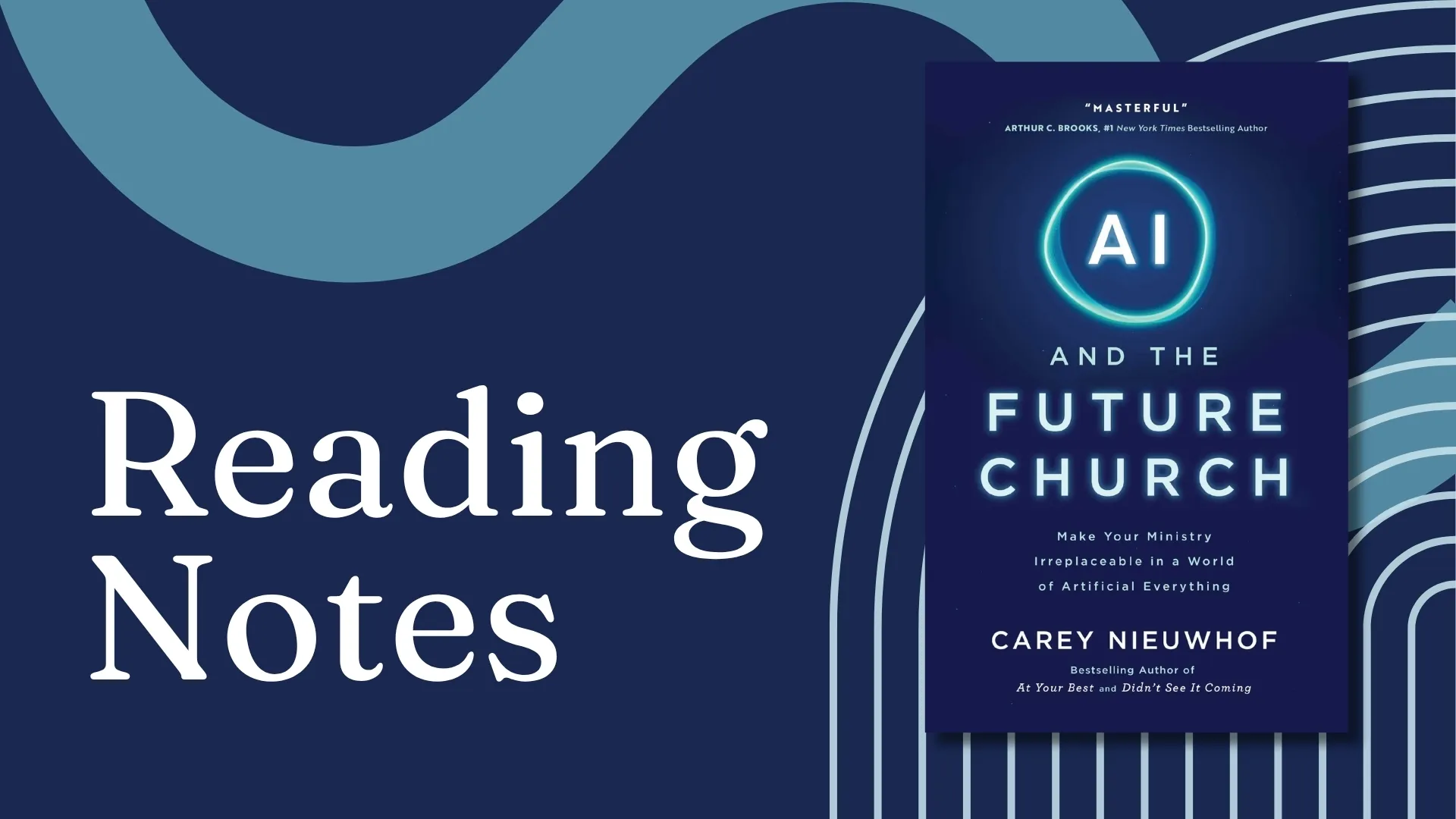
Carey Nieuwhof does a great job framing what church leaders really need to be in tune with as AI continues to disrupt our society. Borrowing a quote from Jeff Bezos, he suggests that, even more so in church work, we should ask what won’t change rather than what will. He also uses futures forecasting to help us understand the context of AI, giving church leaders a picture of what may be coming so they can prepare, positioning the best case against the worst case for an extremely helpful framing for the reader.
What Will Change, and What Won’t
Much of ministry will assuredly change as AI disrupts the lives of congregants around the world. Nieuwhof identifies three main areas where that change will occur: relationships, careers/earnings/identities, and mental health. One of the changes he highlights is closer to home for church leaders: pastors need to fortify their integrity because it will have outsized importance moving forward. While external factors will change, which will in turn change ministries’ internal strategies, a better question for ministries to ask themselves is: What is not going to change regarding meeting these needs?
Nieuwhof identifies factors such as human relationships, pastoral care, and Christianity’s offer of purpose as what will strengthen ministries in the future, and this has basically been the church’s formula all along. Readers should expect a lot of change, but they shouldn’t expect the solutions to those changes to change. The church will continue offering the same solutions, just to different problems, with a willingness to adapt exactly how those solutions look and play out.
Make Sundays Not Downloadable
Nieuwhof’s work reflects some of my own thoughts on what AI will do and how pastors and churches need to adjust. One of the most marketable, trademark catchphrases he develops is “Make Sundays not downloadable.” In a world where Sunday-like content is available everywhere, the church will have to be a destination for community and relationship. It won’t necessarily be about discipleship content, which families can find in abundance outside their local congregation.
Instead of competing directly with other resources online, churches should focus on strengthening the ministries that will be needed as a result of AI disruption. They should also fight back against the loneliness and mental health struggles that will be among the major consequences of AI’s disruption.
Why It’s Timely
We are dealing with AI fears right now, in the summer of ’26. People are reckoning with the harm AI can cause culturally, globally, and economically, not just the boon we’ve seen. We have a chance, at the forefront of rapidly accelerating technology, to put a Christian mark on these tools. Unfortunately, the Christian understanding and approach are already lagging behind and will only worsen as AI accelerates.
I can’t help but think of social media, which the church was so slow to engage. It took COVID to get an earnest try at what that could look like in many of our churches. Now we are faced with a new paradigm, a new technology very different from social media, and we’re already tracking down the same path: allowing AI to shape our congregants, our churches, and our communities without the strong voice and influence that the church, and the Christian community at large, could bring.
My Takeaway
Readers will walk away from this book ready to begin auditing their own ministry contexts: what needs strengthening and what needs resources for the future AI will bring. It will ultimately challenge traditional churches that persist in a Southern Baptist model of meeting inside the church (maybe too much during the week), with no mechanisms in place to help facilitate small groups and discipleship within the community of believers.
Change is incoming and will make an impact. We can plan now and begin approaching it both internally, within our local church context, and externally, alongside other churches, to manage the disruption of AI and promote human flourishing. Or we can let the waves of incoming change toss us around and be beholden to them, rather than guiding our ship as Christians where we would prefer it to go, regardless of how the waves crash.
In light of that, I would encourage all Christians to read this work to help their churches. It offers an easy step forward in learning the technology and engaging with it in a meaningful way that could help their neighbors.